
Polling Shows Public Perception of US Oil & Gas Industry Has Improved Greatly Since 2008
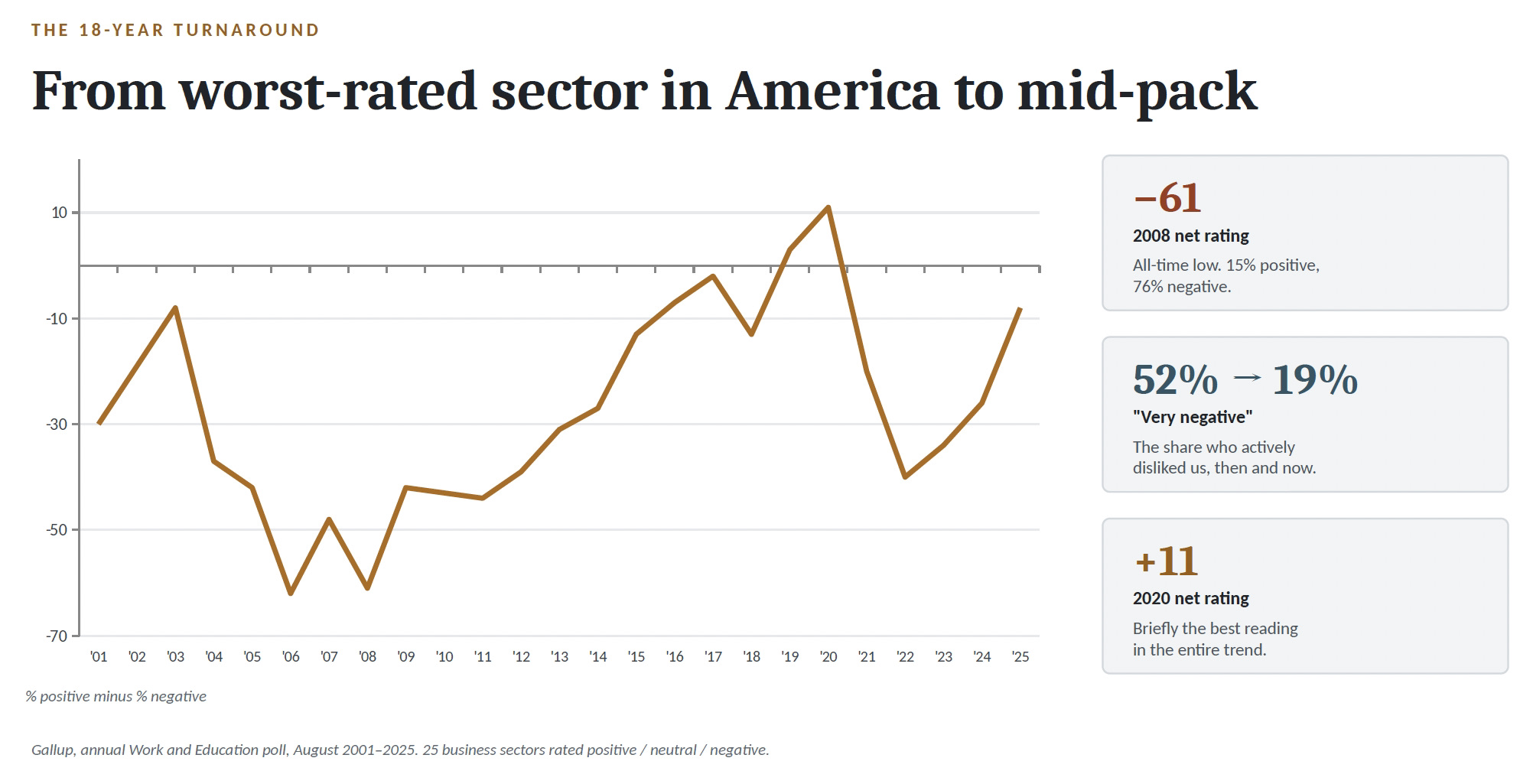
Recent Gallup polling shows public perception of the U.S. oil and gas industry has improved dramatically since hitting rock bottom in 2008. With a net negative 61 percentage point rating in 2008, the oil and gas industry ranked dead last out of 25 major sectors in public approval. Fast forward 18 years, and the oil and gas industry has achieved a 53-point improvement in Gallup’s most recent polling data for 2025, ranking ahead of the federal government, the pharmaceutical industry, healthcare, and television and radio.

The good news for the U.S. oil and gas industry and its proponents: improved public relations and messaging in the wake of high-volume hydraulic fracturing misinformation and subsequent public backlash in the early 2010s seems to have paid dividends. More Americans appear to have embraced energy realism and understand the essential role of oil and natural gas to providing our energy needs. An overwhelming majority of Americans also support increased domestic oil and gas production over reliance on foreign energy.
The bad news: The oil and gas industry is one of 10 major sectors that has a net negative rating. And public perception on the oil and gas industry in recent years appears to be more driven by pump prices than industry messaging.
The oil and gas industry’s highest rating since 2008 came in 2020 (+11), when gasoline prices were just $2.17 per gallon. That rating crashed to a net 40 percent negative rating in 2022 when pump prices soared to record levels.

With those trends in mind, IPRB has emphasized education outreach on gasoline prices in recent months. Factors beyond U.S. oil producers’ control – including high state-level gasoline taxes, global factors driving up global crude oil prices and global refining constraints – are responsible for the relatively high pump prices consumers are paying at the moment. Current pump price increases are also less dramatic when accounting for inflation, and compare favorably compared to consumer costs for many other goods and services whose costs have increased dramatically in recent years and don’t fluctuate downward as pump prices have historically done.
Notably, emerging sectors such as wind and solar energy, data centers and artificial intelligence/cloud computing are not currently included in the 25 major sectors in Gallup’s annual Work and Education polling. Separate Gallup polling show opposition to data centers is over 70 percent, while widespread local opposition to wind and solar projects has been well documented in recent years.
In other words, though the U.S. oil and gas industry is no longer Public Enemy No. 1 in the eyes of the American people. But attitudes toward the industry are still somewhat negative overall.
Looking Ahead
Gallup’s latest Work and Education poll is slated to be released later this month. With pump prices soaring this year as result of the Iran conflict, it will be interesting to see if public perception of the U.S. oil and gas industry takes a hit similar to 2022, when public perception crashed to a -40-percentage point net rating just two years after being 11 points above water.

